Partial Knee Replacement vs Total Knee Replacement — When Is Each Advised?
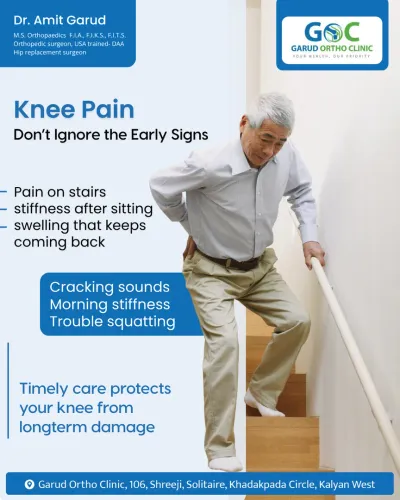
Knee pain from arthritis can slowly take away your ability to walk, climb stairs, or even enjoy daily activities. At Garud Ortho Clinic, Khadakpada, Kalyan West, Dr. Amit Garud, Orthopedic, Arthroscopy & Joint Replacement Surgeon, helps patients understand whether they need a partial or total knee replacement based on the exact pattern of joint damage.
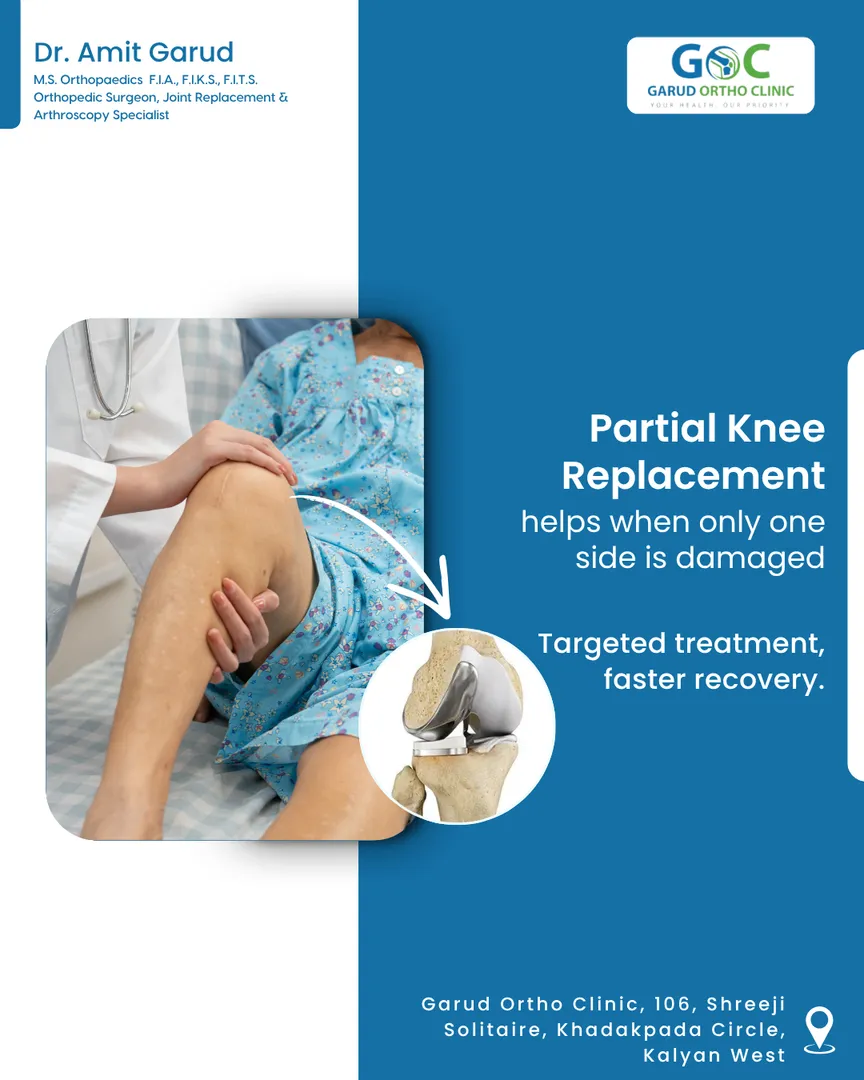
A Partial Knee Replacement (Unicondylar Knee Replacement) is advised when arthritis affects only one part of the knee — usually the inner (medial) side. The rest of the knee, including ligaments and cartilage, remains healthy.
Benefits include smaller incision, less bone removal, faster recovery, more natural knee movement, and early return to routine. It is ideal for younger, active patients or those with early‑stage arthritis limited to one compartment.
A Total Knee Replacement is recommended when arthritis has damaged all three compartments of the knee. Patients usually have severe pain, stiffness, deformity, and difficulty walking even short distances. TKR replaces the entire joint surface, giving long‑term pain relief and improved mobility.
Choosing the right procedure matters because every knee is different. With precise evaluation, Dr. Amit Garud guides patients toward the safest and most effective option for lasting comfort.
If knee pain is limiting your daily life, an early orthopedic consultation can help you regain mobility and confidence.
Knee pain from arthritis can slowly take away your ability to walk, climb stairs, or even enjoy daily activities. At Garud Ortho Clinic, Khadakpada, Kalyan West, Dr. Amit Garud, Orthopedic, Arthroscopy & Joint Replacement Surgeon, helps patients understand whether they need a partial or total knee replacement based on the exact pattern of joint damage.
A Partial Knee Replacement (Unicondylar Knee Replacement) is advised when arthritis affects only one part of the knee — usually the inner (medial) side. The rest of the knee, including ligaments and cartilage, remains healthy.
Benefits include smaller incision, less bone removal, faster recovery, more natural knee movement, and early return to routine. It is ideal for younger, active patients or those with early‑stage arthritis limited to one compartment.
A Total Knee Replacement is recommended when arthritis has damaged all three compartments of the knee. Patients usually have severe pain, stiffness, deformity, and difficulty walking even short distances. TKR replaces the entire joint surface, giving long‑term pain relief and improved mobility.
Choosing the right procedure matters because every knee is different. With precise evaluation, Dr. Amit Garud guides patients toward the safest and most effective option for lasting comfort.
If knee pain is limiting your daily life, an early orthopedic consultation can help you regain mobility and confidence.
Keywords